
LEGENDS Revenue Performance Infrastructure
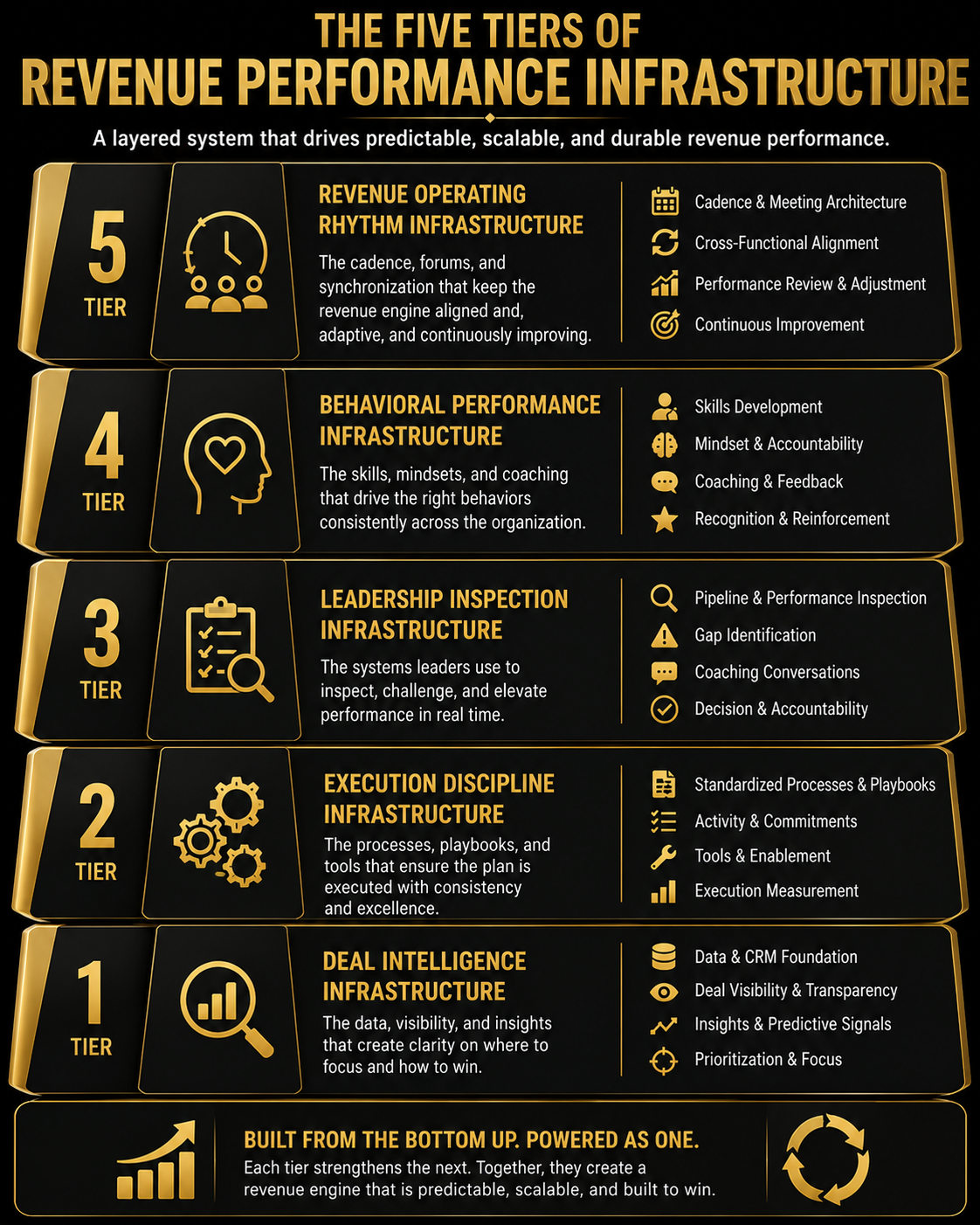
Deal Intelligence
Urgency is the single most important trigger in enterprise sales today because enterprise buyers rarely act based on value alone — they act when the cost of waiting becomes greater than the cost of change.
In complex enterprise deals, organizations almost always agree a problem exists. The challenge is not awareness. The challenge is priority.
Without urgency, enterprise sales stall in “interested but inactive.”
Pain creates awareness. Value creates interest. Trust creates confidence. Urgency creates action.
Enterprise buying is blocked by competing initiatives, executive uncertainty, organizational friction, risk avoidance, political resistance and undefined urgency.
This is why we designed a new, modern sales methodology for today's enterprise environment called Deal Intelligence.
The Deal Intelligence methodology is designed to identify urgency to qualify if the deal is winnable. It optimizes decision reality. It focuses on decision probability or more simply put, winnability.
Deal Intelligence asks, “Will this organization actually buy?” It does this by validating pressure, timing, ownership, process, competitive position and organizational commitment.
The role of the sales organization is to deliver predictable and repeatable revenue. In order to do this consistently it requires a new approach to sales strategy.
Traditionally deal intelligence meant - What do we know about the deal?
Today’s definition of deal intelligence is different.
Deal Intelligence is the ability to predict and influence deal outcomes in advance.
Deal Intelligence ensures that every deal is intentional, every opportunity is qualified and every action moves the deal closer to a win.
The Deal Intelligence Operating System
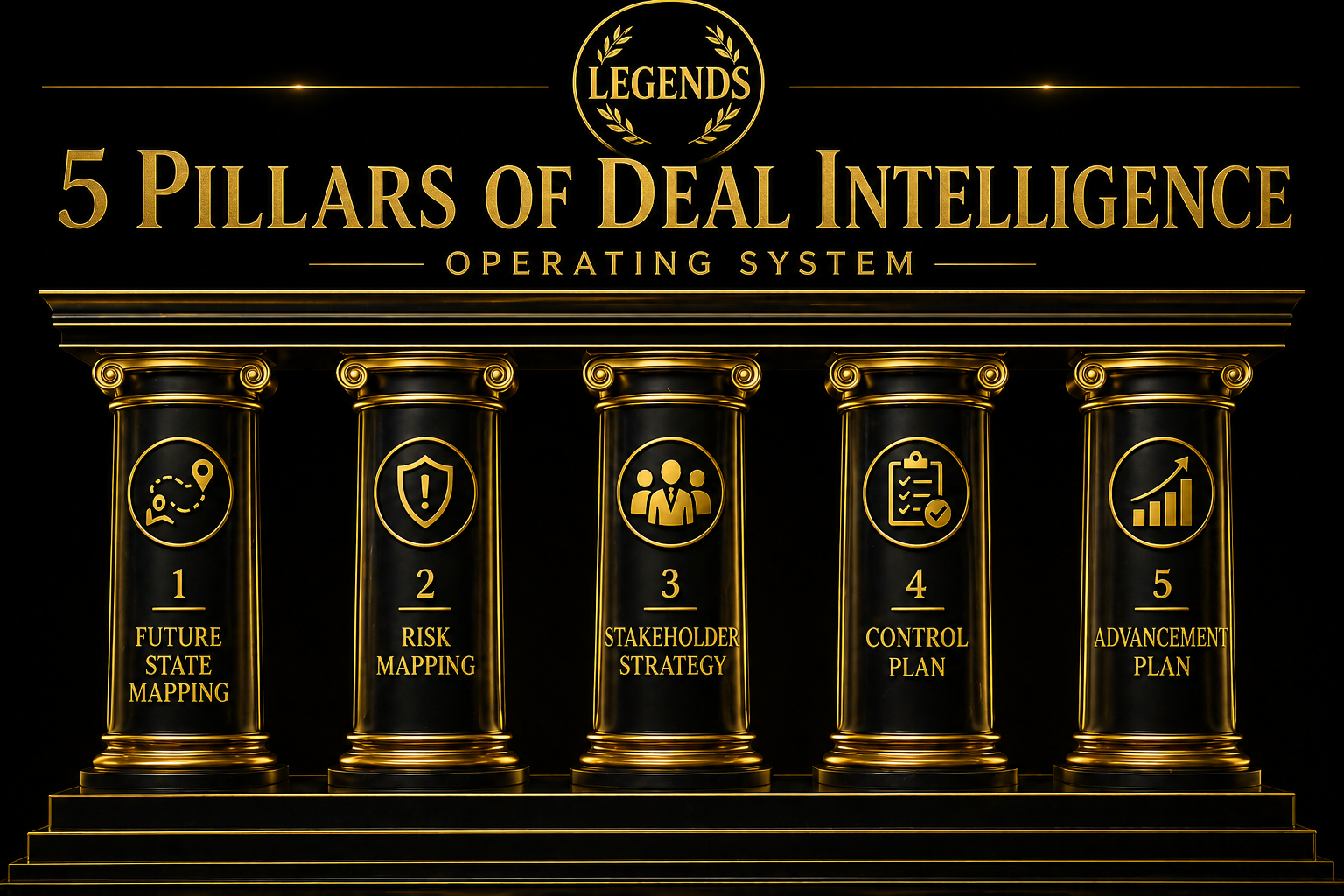
Deal intelligence is the progression from deal awareness, to deal control, to deal prediction. The concept is not new but the principal is refined to a more prescriptive operating system rooted in deal discipline.
Moving from an activity driven sales motion to a deal execution motion requires sales teams to implement a structured framework. The framework allows for greater control and predictability and less opinion and ambiguity. Every deal in the pipeline is being evaluated for future clarity, risk exposure, stakeholder alignment, process control and next steps precision.
There are 5 execution pillars to implementing deal intelligence.
Future State Mapping - Define what must be true for the deal to close
Risk Mapping - Identify where the deal will break—before it does
Stakeholder Strategy - Align the people who actually decide the outcome
Control Plan - Intentional action maintains deal momentum
Advancement Plan - Define the exact next step that moves the deal forward
When all five of the pillars are strong, deals move faster and with more accuracy and win rates increase. When one breaks the deal breaks.
P5 Deal Execution Control System
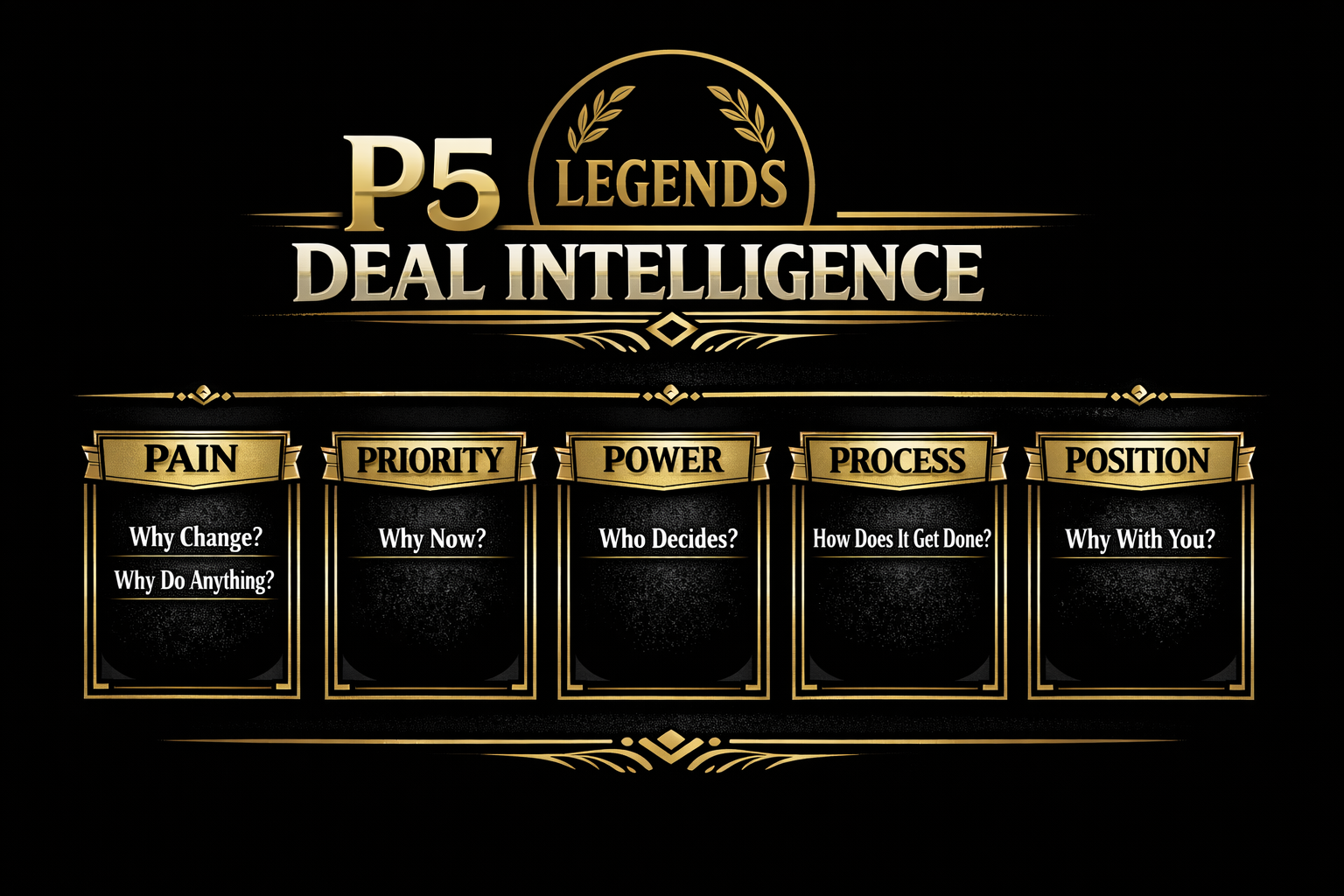
The Deal Intelligence Operating System is powered by the P5 Deal Execution Control System.
The P5 Framework identifies whether a deal is truly executable. It is engineered to ensure every deal is real and winnable.
This is not just a qualification checklist of criteria similar to MEDDPICC. This is an operational framework that works as the deal execution control system.
Most sales frameworks fail because they:
Confuse activity with progress
Rely on champions instead of power
Discover problems too late
P5 forces reality early. It makes execution visible, measurable, and coachable.
P5 doesn’t help you understand your deals — it ensures you control them. It is engineered to ensure every deal is real, winnable and executable.
P5 - A Modern Refined Approach to MEDDPICC
MEDDPICC has proven to be highly effective for qualifying and inspecting deals, it’s been battle tested for nearly 40 years.
But on its own, it does not ensure deal progression or control—which is where modern execution-focused frameworks are needed to create additional leverage.
MEDDPICC tells you what to check. It is not a decision framework.
That is the reason why MEDDPICC needs refinement. It has started to fail as a framework for predictability. It has morphed into a deal Inspection framework vs a deal execution framework.
MEDDPICC has become a static qualification checklist. It’s diagnostic and often retrospective. P5 is a framework built to operationalize a Deal Intelligence system. It is dynamic, predictive and execution-focused.
In today’s enterprise environment more pipeline does not equate to more revenue and more activity does not equate to more wins.
MEDDPICC still helps managers inspect deals but P5 is designed to help sellers win more deals. P5 doesn’t ignore the components of MEDDPICC. It absorbs and operationalizes it into how deals actually move.
Mapping MEDDPICC to P5
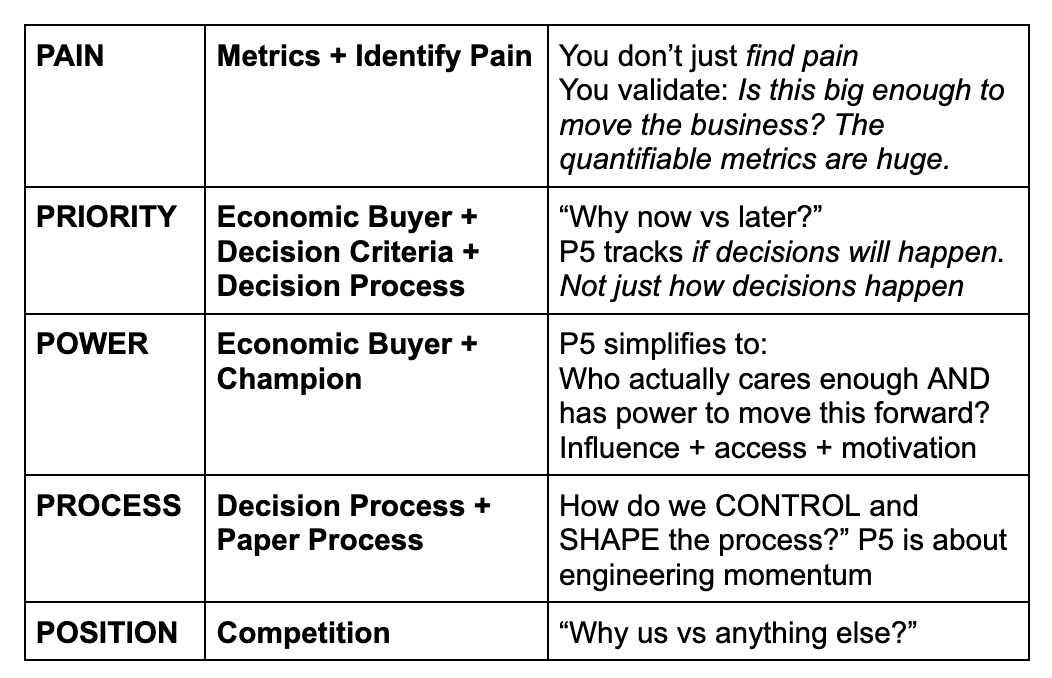
Advantages of the P5 Framework
Explicitly Captures Urgency (Where MEDDPICC Falls Short)
Integrates Execution Into Qualification
Is Predictive, Not Just Diagnostic
Is Built Around Buyer Decision Dynamics (Not Seller Process)
Simplifies Without Losing Depth
Reflects How Elite Sellers Actually Operate
The advantage today goes to teams who can identify real deals early based on urgency and priority.
To teams that can disqualify quickly and kill weak deals fast without wasting resources.
Allowing the company to double down on winnable opportunities.
P5 better accomplishes this by offering a streamlined framework to gain:
Clarity on Pain
Conviction on Priority
Access to Power
Control of Process
Strength of Position
The Performance Impact
P5 is a performance based revenue execution system. That means the outcomes aren’t theoretical—they show up directly in pipeline quality, forecast accuracy, and closed revenue.
When implemented, leadership and sellers will begin to see measurable results in the first 90 days.
Performance Impact
+5–15% win rate lift (most immediate impact)
10%–25% reduction in sales cycle length (deal velocity)
Forecast accuracy improves from ~60–70% → 85–95%
10%–20% increase in average deal size
Reduced late-stage slippage
Pipeline Quality
20–40% reduction in low-quality deals
Clearer qualification standards
Execution
10%–30% reduction in discounting
15%–25% increase in productive selling time
Stronger next-step discipline
Increased multi-threading
2–3x increase in executive-level meetings
These are not just one time improvements. P5 works because it enforces five non-negotiables in every deal:
Pain → ensures the deal is real
Priority → ensures it will happen now
Power → ensures someone cares enough to act
Process → ensures it can actually close
Position → ensures you are the one who wins
Most frameworks (including MEDDPICC) track deals. P5 is designed to enhance the probability of winning deals.